

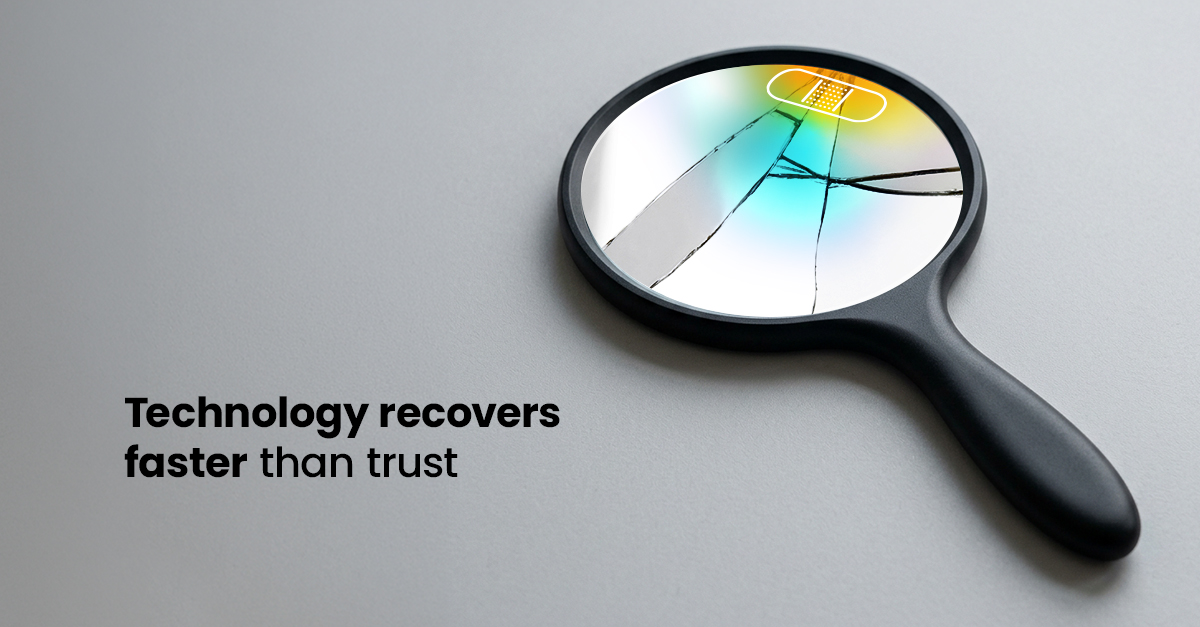
The cost of every minute of downtime is two-fold. One part is tangible; the other is not.
Where you see a technical glitch that needs addressing and resolving, your customers see a company that let them down and wonder whether this might happen again.
While your system may be restored in hours, that question may linger far longer.
Here’s the way the negative effects of downtime spread beyond your technical infrastructure.
Customers begin doubting your reliability
Your customers trust that you’ll be there when they need you to be. This assumption forms the foundation for all of their interactions with your business.
When you’re unavailable, that trust is shaken. The problem that seems only temporary to you makes customers question your reliability.
This new perspective alters the entire customer experience. Time drags on longer and problems become more noticeable.
Prospects become your competition
Downtime affects not only your current customers; it affects prospects who you’ll never hear from.
Your prospects will typically contact you once they are ready to purchase something, which is the moment they’ve finished researching their options. And that window is quite limited – and you need to be present there.
Once your customers cannot contact you at that time, they simply move on to your competition.
This will not appear in any report or analytics dashboard for you; there is no way to track those lost opportunities.
Negative experiences spread faster than positive experiences
Smooth experience will go unnoticed, but a bad one can spread quickly.
The experience of not being supported during an outage can be discussed by prospects during their conversations, peer groups, professional circles and online communities.
In addition, negative online reviews become even easier to share, especially once there are just a few reviews related to the same outage – and they can create a negative impression among prospects who did not work with you before.
In many cases, they can appear in search results just when those prospects start researching their options.
Another effect that may prove hard to measure involves customer advocacy. Negative experiences discourage recommendations, and this reduces the referrals that often present you with some of the best opportunities.
Trust recovery is slower than technology recovery
Recovery from an IT incident isn’t enough to bring your business back to where it was before.
When a disruption occurs, there’s a shift in expectations. Customers are less tolerant of mistakes, and also less inclined to engage with your business. In some cases, customers will begin to doubt your reliability even after the problem has been fixed.
This impact may not be readily visible through your metrics, but by the time it affects your metrics, its effect on your bottom line is already set.
Are you prepared to recover at a moment’s notice?
While a recovery plan can’t guarantee that nothing ever goes wrong, it determines how you respond when things do go wrong.
Your response influences how much trust you retain, and customers judge your response under pressure rather than how quickly you fix your system.
What remains to be determined is not whether something will go wrong but whether you’ll be prepared for it.
Make a 10-minute discovery call with us to evaluate where you stand, find gaps, and leave with a solid plan so that you are prepared in case anything fails.